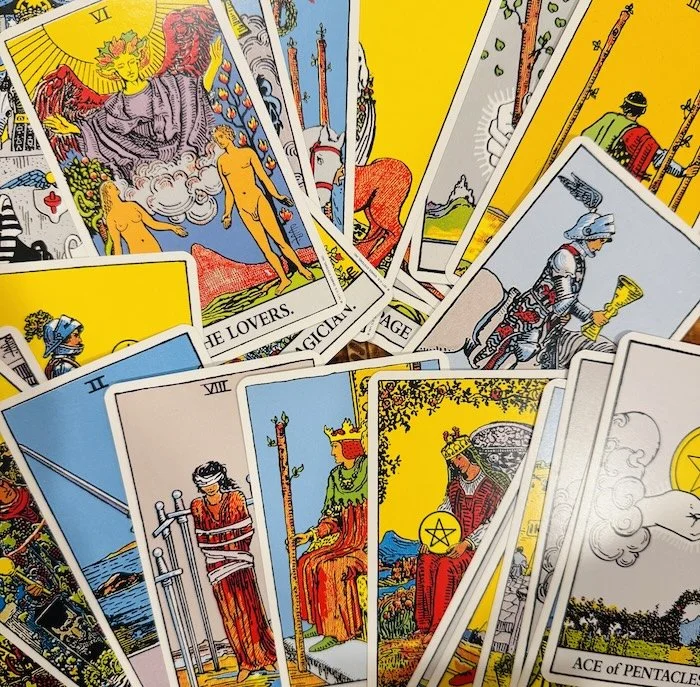
The first time I used tarot in a session, it happened organically. A patient was talking about a subpar tarot reading they had over the weekend, and they said, “Oh, you probably think that’s dumb.” I answered honestly, “Not only do I not think it’s dumb, but I also have a deck right here and use it myself.” She asked me to pull a card for her, and I offered to do it at the end of the session. With an affirmative nod, she circled back to the weekend and how her friends hadn’t come through for her, and a new part of our dynamic was born. That was two years ago, and she still asks for a card at the end of each session.
I don’t always give patients what they ask for. I use self-disclosure only when clinically necessary. I don’t tell them what to do in a tricky situation(I do ask a lot of questions to help them get to the answer on their own). Sometimes they ask me my opinion, and I respond by asking them why my opinion would be useful. In most cases, therapists respond with a well-thought-out question in return to encourage curiosity and lead them towards insight.
So, why did I say yes to this request?
In 2021, I began studying tarot. I used the cards in a few ways, but mainly as a grounding force during a time when things felt particularly unstable in the world. I asked the cards every morning after I meditated, " What do I need to know today?, pulled a card, studied the imagery, consulted the tiny guidebook, and metabolized the message, all the while doing square breathing. I found the practice calming, and it stimulated more insight into my emotional landscape. Back then, it never occurred to me to use tarot in my therapy practice. Until that one patient asked me to. After that session, I noticed a change in this particular patient. She thought about the card between sessions. She noticed that the theme came up in her life during the previous week and was more frequently questioning why she had done what she did and how those actions had impacted her emotional world. The cards seemed to aid in her self-reflection.
I do not use tarot in psychotherapy sessions to be predictive. I incorporate it as a reflective tool to support psychodynamic exploration with both individuals and groups. I invite patients to engage with the imagery of the cards as a way to project and process unconscious thoughts, emotions, and relational patterns that may be difficult to access directly. In group settings, tarot can foster shared insight and dialogue, helping members deepen empathy and better understand both their own inner experiences and the dynamics within the group.
In session, I ask patients who are interested in using tarot to take a few grounding breaths and close their eyes. We both focus on what the patient is interested in knowing more about as I shuffle the cards. When they say “stop," I divide the cards into three piles and, intuitively, choose the card that feels right. Together, we explore the meaning of the card to the patient using guiding questions:
What do you see in the imagery of the card?
What do you feel in your body when looking at this card?
How does it connect to what we have been talking about?
Is there anything else it brings up emotionally?
Once we have explored these questions, we discuss the meaning assigned to the card, and I ask, “What will you take with you after interacting with this card? What are the questions you will ponder or insights you will hold on to?”
The benefits of incorporating this into my therapy practice have been numerous. I’ve seen patients gain a much deeper understanding of themselves. Sometimes the cards elicit new memories to explore. Patients start new creative and grounding practices based on the cards we have pulled. It seems to open up exciting opportunities for them to see the situations they find themselves in and their identity in a new light.
When I started offering therapeutic groups that use tarot, I did a quick Google search for new places to advertise to find people interested in this kind of exploration. I found myself joining a 4000-member Facebook group called “Therapist who Tarot.” I could not believe there were so many other clinicians out there utilizing Tarot and so many more intuitive practices (mediumship, astrology, and so much more).
Through this group, I also found the first tarot certification course ever to be offered in the United States, “Tarot Certificate Program: The Clinical Use of Tarot Card Imagery in Psychotherapy.” I signed up for the first open weekend (September 2026). By mid-January, when I learned of it, all three of the other trainings were already full, and I’m not surprised. In the last few years, I have encountered a new level of people searching for meaning in once more novel mediums, such as witchcraft or tarot.
Tarot gave me a sense of control when I felt uncertain-perhaps that is what people are seeking, as recent history has exposed us to an immeasurable amount of chaos in our daily lives.
Utilizing tarot in therapy isn’t for everyone, and I respect that. However, if you find yourself in the mood to mix it up with some spicy psychology and want to use tarot for insight and growth, you now know where to find someone who can help you do it.
References:
https://cascadia-training.com/course/tarot-certificate-program-march-2027/
https://www.vogue.com/article/tarot-and-oracle-decks-rising-popularity