
• Home
  • Relationship Therapy
  • Life Transitions
  • Tarot
  • Blog
  • About Me
Menu

Jianna Heuer, LCSW

Street Address
New York NY 10038
917-830-8962
Psychotherapist

Your Custom Text Here

Jianna Heuer, LCSW

  • Home
  • Relationship Therapy
  • Life Transitions
  • Tarot
  • Blog
  • About Me

Sitting With Your Feelings

September 6, 2026 Jianna Heuer

One of the hardest concepts for people to grasp in therapy is the idea of “sitting with your feelings.” Every time I have suggested this to a patient, I get the same response: a slight tilt of the head and a quizzical look. Seconds after I suggest the idea of sitting with their anger, sadness, or frustration, I get the inevitable question of “how?”

When I started going to therapy, the emotion I was most in touch with was anger. Sadness was buried. Happiness fleeting. Rage could be summoned with the wrong kind of look from a stranger or a stray thought about a real or imagined annoyance. I could be in that feeling all day long, often acting on it in subtle ways, mostly toward myself, sometimes projecting it onto others. I wasn't sitting in my feelings; I was stewing in them.

So what's the difference?

Stewing is a form of rumination where one dwells on a distressing thought, emotion, or situation on a loop. I often wouldn’t know I was angry; I would act out and then realize, oh, look, you're pissed. Once aware of the rage, I would fixate on something or many frustrating things, which would only increase the feeling, making me want to engage in more destructive behavior or thinking. I never stopped to try to understand where the feeling came from. I never asked myself “How did it start?” Or  “What precipitated it?” Or, “Now that I know I'm angry, what do I want to do with it? I reacted instead of responding.

Sitting with your feelings is different. After years of my own therapy, practicing observing myself in new ways, I am aware of my feelings not just in thoughts but in my body. I feel the feeling everywhere. Anger often appears as a tension headache or a stomach ache for me; sadness can feel like heaviness in my chest or legs. Once aware I’m having a strong emotion, I accept it and try not to judge it. As I attempt to understand where it came from and why I’m in it, I notice the feeling lessens instead of intensifying. Sitting with it lets it pass through me rather than getting lodged and stuck in places that cause discomfort or anguish.

Therapy is incredibly useful in practicing this skill in real time with another person. Another great tool I use is tarot.

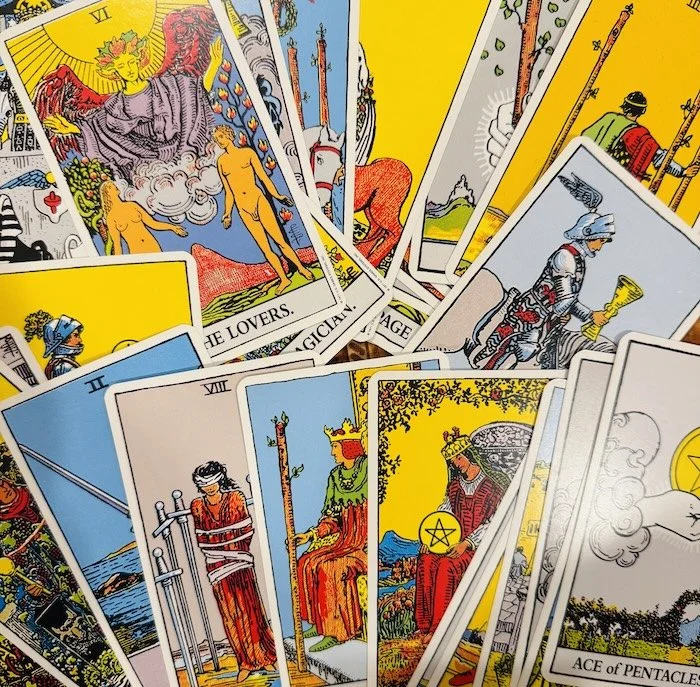
When I feel like I’m teetering between stewing and sitting, I pull a card or give myself a full reading.  Every card is connected to an element and an emotional experience. If I am angry and I pull the Three of Swords (often associated with emotional pain and heartbreak), I let myself consider whether there are other emotions beneath the anger. If I’m feeling sad and can't quite put my finger on why, pulling the Six of Wands could help me consider whether the reason is that I am feeling overlooked or less confident in myself than usual. The card becomes the mirror that reflects back what I couldn’t see in myself on my own.  This allows me to be open to understanding my feelings in new ways, so I can sit with them long enough for them to move into a less active place, or altogether pass.

I know that when I say to a patient, “Can you sit with this feeling?” It can be scary and frustrating. It may even feel like I’m asking them to do the impossible; I know it's felt that way for me at times. But as they do it more, just as I did, the agency felt in being able to manage hard emotions in new ways is worth the moments of discomfort in the process. Sitting with your feelings will make them yours, something that you move through, not something that is moving you.
Tags tarot, sitting with feelings, frustration, anger, sadness, therapy

How I Use Tarot as a Therapeutic Tool

April 16, 2026 Jianna Heuer

The first time I used tarot in a session, it happened organically. A patient was talking about a subpar tarot reading they had over the weekend, and they said, “Oh, you probably think that’s dumb.” I answered honestly, “Not only do I not think it’s dumb, but I also have a deck right here and use it myself.” She asked me to pull a card for her, and I offered to do it at the end of the session. With an affirmative nod, she circled back to the weekend and how her friends hadn’t come through for her, and a new part of our dynamic was born. That was two years ago, and she still asks for a card at the end of each session.

I don’t always give patients what they ask for. I use self-disclosure only when clinically necessary. I don’t tell them what to do in a tricky situation(I do ask a lot of questions to help them get to the answer on their own). Sometimes they ask me my opinion, and I respond by asking them why my opinion would be useful. In most cases, therapists respond with a well-thought-out question in return to encourage curiosity and lead them towards insight.

So, why did I say yes to this request?

In 2021, I began studying tarot. I used the cards in a few ways, but mainly as a grounding force during a time when things felt particularly unstable in the world. I asked the cards every morning after I meditated, " What do I need to know today?, pulled a card, studied the imagery, consulted the tiny guidebook, and metabolized the message, all the while doing square breathing. I found the practice calming, and it stimulated more insight into my emotional landscape. Back then, it never occurred to me to use tarot in my therapy practice. Until that one patient asked me to. After that session, I noticed a change in this particular patient. She thought about the card between sessions. She noticed that the theme came up in her life during the previous week and was more frequently questioning why she had done what she did and how those actions had impacted her emotional world. The cards seemed to aid in her self-reflection.

I do not use tarot in psychotherapy sessions to be predictive. I incorporate it as a reflective tool to support psychodynamic exploration with both individuals and groups. I invite patients to engage with the imagery of the cards as a way to project and process unconscious thoughts, emotions, and relational patterns that may be difficult to access directly. In group settings, tarot can foster shared insight and dialogue, helping members deepen empathy and better understand both their own inner experiences and the dynamics within the group.

In session, I ask patients who are interested in using tarot to take a few grounding breaths and close their eyes. We both focus on what the patient is interested in knowing more about as I shuffle the cards. When they say “stop," I divide the cards into three piles and, intuitively, choose the card that feels right. Together, we explore the meaning of the card to the patient using guiding questions:

What do you see in the imagery of the card?

What do you feel in your body when looking at this card?

How does it connect to what we have been talking about?

Is there anything else it brings up emotionally?

Once we have explored these questions, we discuss the meaning assigned to the card, and I ask, “What will you take with you after interacting with this card? What are the questions you will ponder or insights you will hold on to?”

The benefits of incorporating this into my therapy practice have been numerous. I’ve seen patients gain a much deeper understanding of themselves. Sometimes the cards elicit new memories to explore. Patients start new creative and grounding practices based on the cards we have pulled. It seems to open up exciting opportunities for them to see the situations they find themselves in and their identity in a new light.

When I started offering therapeutic groups that use tarot, I did a quick Google search for new places to advertise to find people interested in this kind of exploration. I found myself joining a 4000-member Facebook group called “Therapist who Tarot.” I could not believe there were so many other clinicians out there utilizing Tarot and so many more intuitive practices (mediumship, astrology, and so much more).

Through this group, I also found the first tarot certification course ever to be offered in the United States, “Tarot Certificate Program: The Clinical Use of Tarot Card Imagery in Psychotherapy.” I signed up for the first open weekend (September 2026). By mid-January, when I learned of it, all three of the other trainings were already full, and I’m not surprised. In the last few years, I have encountered a new level of people searching for meaning in once more novel mediums, such as witchcraft or tarot.

Tarot gave me a sense of control when I felt uncertain-perhaps that is what people are seeking, as recent history has exposed us to an immeasurable amount of chaos in our daily lives.

Utilizing tarot in therapy isn’t for everyone, and I respect that. However, if you find yourself in the mood to mix it up with some spicy psychology and want to use tarot for insight and growth, you now know where to find someone who can help you do it.

References:

https://students.bowdoin.edu/bowdoin-science-journal/science/its-in-the-cards-a-dive-into-tarot-card-psychology-interpretation-and-therapeutic-applications/

https://cascadia-training.com/course/tarot-certificate-program-march-2027/

https://www.vogue.com/article/tarot-and-oracle-decks-rising-popularity

In Tarot Tags tarot, witchcraft, insight, growth, therapy practice, New York City, financial district, group therapy, therapy, psychotherapy